


Top 5: unusual museums you absolutely have to visit
Luxembourg has a vast network of museums and museum institutions, reflecting a remarkable cultural richness that combines fine arts, history, science, and discovery. Alongside the best-known museums, there are also some true hidden gems: unique places dotted across the Grand Duchy. We selected one from each region.
Aviation Museum
Let’s be clear from the start: the Luxembourgish Aviation Museum isn’t a huge hangar displaying a large collection of military and civilian aircraft. Instead, it’s a discreet venue that presents a comprehensive overview of the country’s aviation history.
This small, two-storey museum, which opened in 2012 in the former Source Kind Pavilion in Mondorf-les-Bains thermal park (Pdf), tells the story of Luxembourgish aviation from the start of the 20th century. The exhibition site also honours the spa town itself, since the first-ever flight over Luxembourg took place in Mondorf in 1910.
Through historical photographs, pilots’ uniforms and flight instruments, the museum explores every facet of aviation, from the age of the pioneers and the beginnings of hot-air ballooning to the advent of commercial aviation.
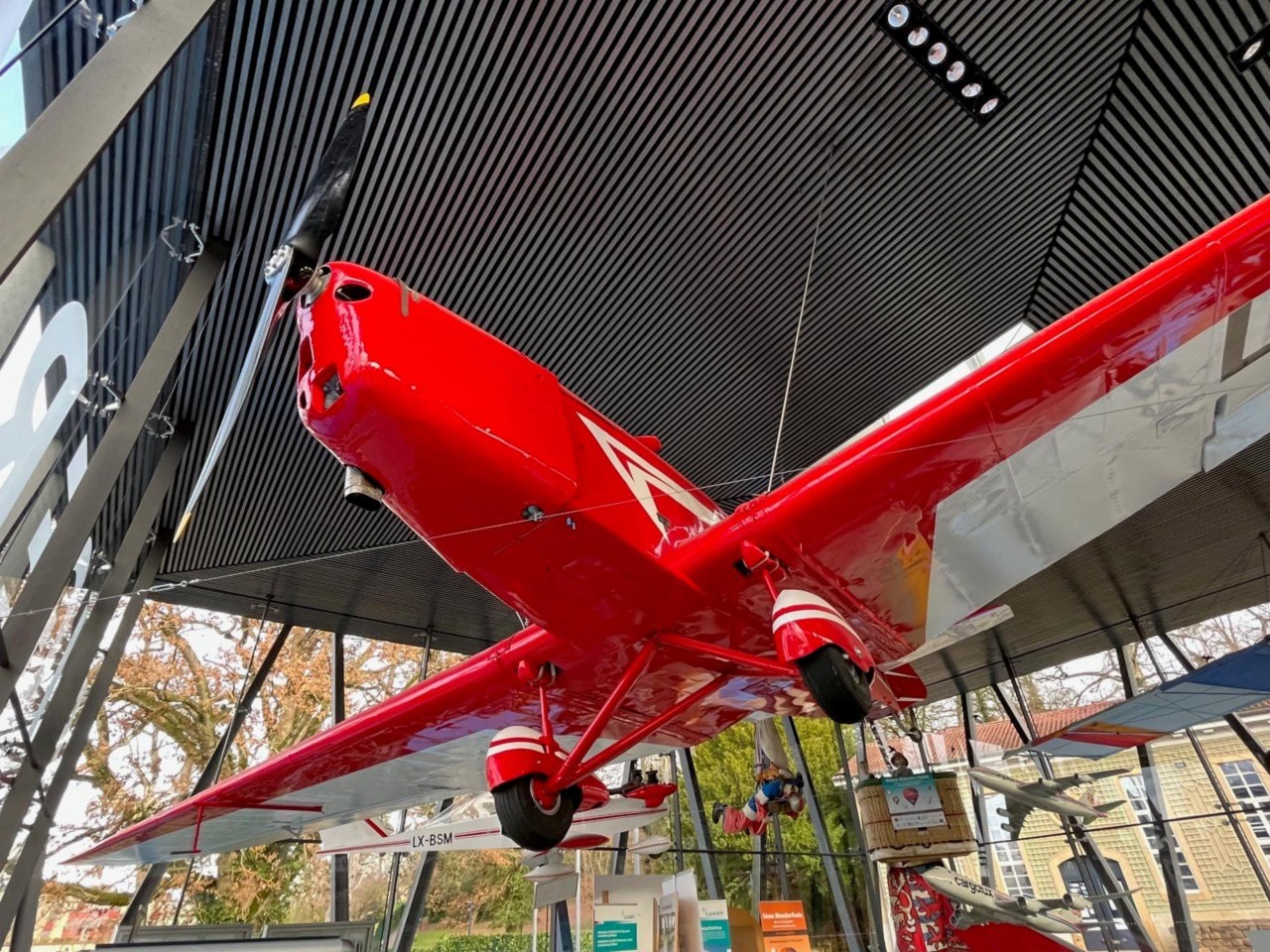
The museum’s true showpiece, the 1934 Klemm monoplane, immediately attracts the eye with its bright red wings.
Run by aviation enthusiasts, the museum is constantly expanding. Guided tours are available on request.
Opening hours:
- Closed on Monday & Tuesday
- From Wednesday to Sunday: 2 to 6 p.m.
Muerbelsmillen
To discover the history of the Muerbelsmillen we have to go back as far as the 11th century. At that time, this former watermill nestled in the heart of the Pétrusse Valley harnessed the forces of nature to grind grain for the local inhabitants. In fact, this old building was still a working mustard mill until 1985.
Although the millstones no longer turn, the heart of the Muerbelsmillen still beats today. The large water wheel that once powered the mill remains the most striking feature of the site. Information panels tell the story of the site, alongside a large wall covered in multilingual slogans that reveal the spirit of the place: "Wir geben unseren Senf dazu", "Dir sidd awer schéi gemoschtert", "On va s'amuser à la moutarde" or "We bring mustard after meat".
Today, this al Moschterfabrick (former mustard mill) tells the story of traditional mustard-making through guided tours. On the upper floor, visitors can discover the mill’s original equipment, gears and historic millstones once used for grinding. At the same time, a historical film demonstrates how the machinery worked and explains the different stages of production.
While the projections enable visitors to understand the mustard-making process, workshops give them a chance to get hands-on. Better still, they can make their very own jar of mustard using the traditional methods of decades past.
Opening hours:
- Saturday: 2 to 6 p.m.
- Sunday: 2 to 6 p.m.


Carriage Museum
Welcome to the world of carriages. This museum in Peppange dedicated to these vehicles from a bygone era holds one of the most significant and remarkable collections of its kind, with over 33 historical carriages from the 19th century. Seven of these vehicles belonged to the Grand-Ducal Court.
The exhibits are displayed in a former farmhouse, where visitors can also discover a fully reconstructed coach-building workshop, as well as an exhibition tracing the history and evolution of horse-drawn vehicles. In addition, a wide range of accessories – harnesses, lanterns, trunks, travel items, as well as a genuine Louis Vuitton suitcase dating back to 1910 – immerse visitors in an era when the carriage was the main means of transport for wealthy people.
The jewel of the collection is the Grand Gala Carriage, which was used for the wedding procession of Grand Duchess Charlotte and Prince Félix in 1919, and which still belongs to the Court today. The museum’s collection also includes the last postal carriage that operated in the north of the country until the early 1930s.
Opening hours:
- Only open on Sundays from 1 March to 31 October (2 to 6 p.m.).
- Closed from November to February.
Textiles Museum
As you step through the museum doors, you can almost imagine hearing the machines still whirring and the reels still working away relentlessly. Once upon a time, weaving was an integral part of everyday life in Larochette. Its activity dates back more than 640 years and has its roots in the Middle Ages. At that time, only wool from the region, as well as from Éislek and Eifel, was processed. Over the years, this traditional craft evolved, and with the advent of industrialisation, many weavers moved to Larochette.
The Sinner-Even and Nicolas Ludovicy-Scharlé spinning mills, the Bonne-Sichel and Vestimenta S.A. dye works, among many others, operated at full capacity for nearly two centuries, until the last factory closed in 1985.
Today, their history lives on at the Textiles Museum. In the annex of the former Jhangli railway station, spools of thread and weaving machines immerse visitors in the golden age of the industry. Beyond this journey into the past, the museum also presents the traditional techniques and equipment used in the production process.
But that’s just one part of the museum in Larochette. The other part highlights a more current aspect of the fashion industry, particularly the impact of fast fashion. Created as part of the Rethink Your Clothes awareness campaign led by the NGO Fairtrade Lëtzebuerg, the exhibition invites visitors to rethink their consumption habits and promote a more sustainable approach to fashion.
Opening hours:
- Monday & Tuesday: 10 a.m. to 12.30 p.m. / 1.30 to 4.30 p.m. (only open to groups, by appointment)
- Wednesday & Friday: 12 to 9 p.m.
- Saturday & Sunday: 10 a.m. to 4 p.m.


Automotive Museum
To discover a collection of legendary vehicles from automotive history, look no further than the Conservatoire National de Véhicules Historiques in Diekirch – a true delight for anyone who appreciates beautiful machines.
The former Jean Wagner car factory highlights the history of the automobile and of motorised transport in general. In 1871, the building was used for making carriages – a starting point that, in a way, foreshadowed its destiny as an automotive museum. As of 1908, Benz vehicles were sold there, and in 1912, the site became the first international Mercedes-Benz dealership. One part of the exhibition is dedicated to this development.
The collection also features an area devoted to the Luxembourgish pilot Nicolas Koob. His career is retraced through personal belongings, trophies, historical documents and sporting memorabilia.
A major highlight of the exhibition is undoubtedly the section devoted to women (Equality on Wheels) and their contribution to the automotive world in Luxembourg. It tells the life stories, passion, innovation and commitment of women in the world of motoring. Among the exhibits is the racing suit worn by Luxembourgish driver Jenny van Hilten.
Alongside the vehicles and a workshop showcasing the development of automotive professions, enthusiasts can also admire some historic motorcycles, including a Luxembourgish STEWA (Steffen Walferdingen) model, as well as an original Wagner carriage.
In addition to the permanent exhibitions, the Conservatoire National de Véhicules Historiques also presents temporary exhibitions each year, which invite visitors to discover a new topic. Each one is devoted to a country, a brand, a prominent figure or a historical/societal issue.
Opening hours:
- Tuesday to Sunday: 10 a.m. to 6 p.m. (Last entry: 5.45 p.m.)
Last update