


Luxembourg Art Week: THE unmissable event for contemporary art
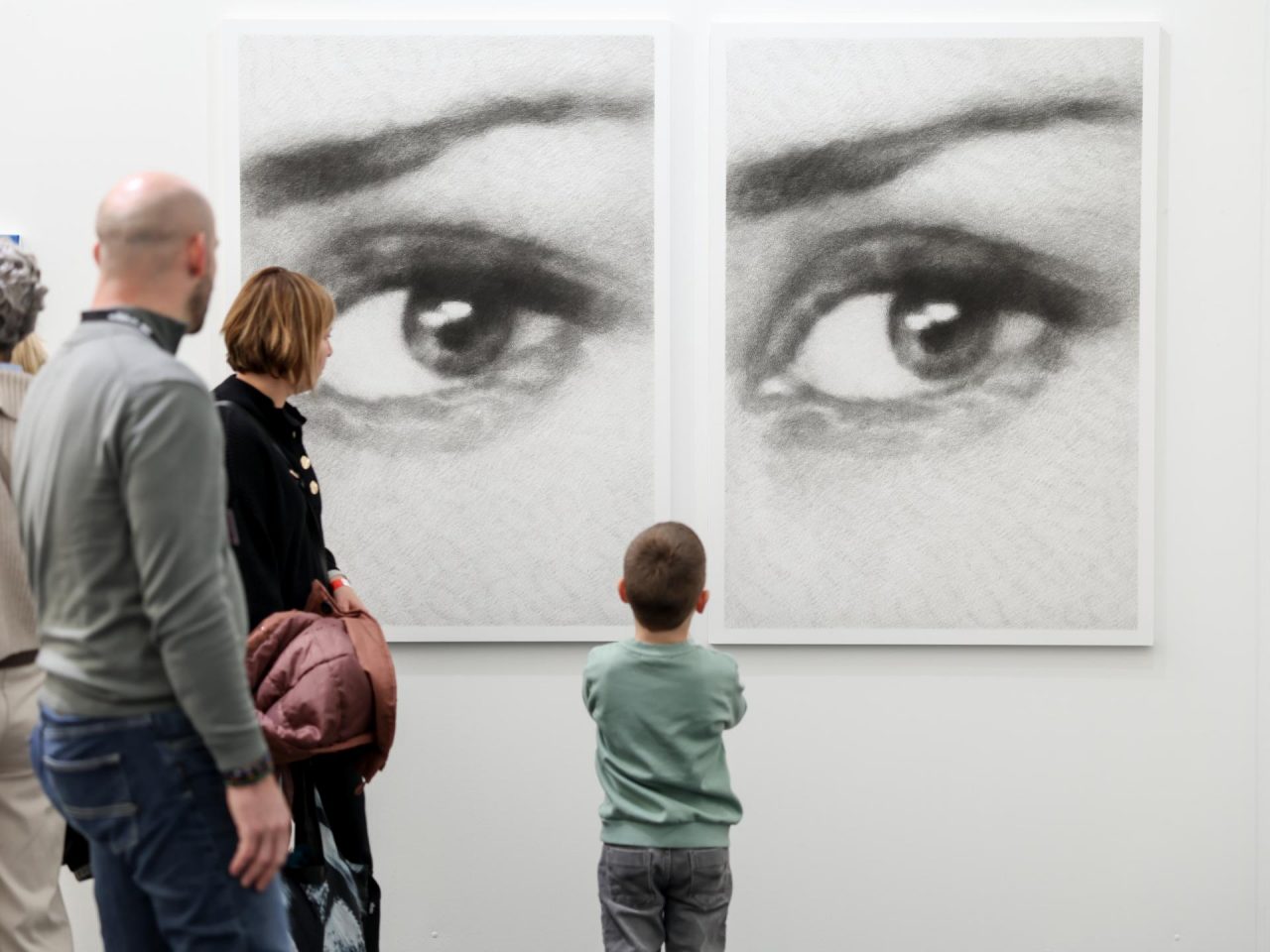
Since its launch in 2015, Luxembourg Art Week has established itself as Luxembourg's leading contemporary art event. The 12th edition will take place from 20 to 22 November 2026 on Glacis Square, bringing together 78 exhibitors from 15 countries, including 18 galleries from Luxembourg. With almost 80% of participants coming from abroad, the event demonstrates its appeal well beyond the Grand Duchy's borders.
An event open to all
Beyond its commercial dimension, Luxembourg Art Week stands out for its commitment to make contemporary art accessible to a wide audience.
The Art Talks bring artists and specialists together to discuss the issues shaping contemporary creation. The discussions are also available afterwards on the Art Talk Rewind podcast.
The event's scope also extends far beyond the fair itself. In cooperation with galleries, cultural institutions and local partners, it offers an extensive off-site programme that invites the public to discover contemporary art in various locations around the capital.
With the Art Walk, Luxembourg Art Week also spills out into the city streets. The route includes the Sculpture Trail, comprising 11 sculptures dotted throughout the city, and Capsules, a series of installations showcased in vacant shop windows.
Luxembourg Art Week is a catalyst: a moment when the energies of the market, institutions, partners and the city come together and become visible as one. Without seeking to replicate major international models, but rather to establish an event in Luxembourg that can hold its own among them, with its own voice: demanding, open, curious and profoundly European.
Mélanie de Jambline de Meux, Director of Luxembourg Art Week
Photography in the spotlight
After having devoted its previous edition to Montreal, this year Luxembourg Art Week is putting photography in the spotlight.
With the Focus Photo theme, the programme forms part of the Bicentenary of Photography celebrations, highlighting the diversity of photographic practices today.
This choice also reflects the prominent role played by photography in Luxembourg, thanks in particular to the legacy of the Luxembourgish-American photographer Edward Steichen and to the dynamism of the many cultural institutions, organisations and initiatives working in this field.
A new contemporary creation prize
This year, Luxembourg Art Week is launching the Contemporary Art Prize, a new award aimed at supporting artists from the Greater Region and the Benelux.
Awarded by an independent jury, it will recognise a work of art presented at the fair. The winning work will then become part of the Société Générale Luxembourg Art Collection.
Ten artists from the Greater Region and the Benelux have been shortlisted for this first edition.
The prize ceremony will take place on 19 November 2026, before the official opening of the fair.
3 questions for Alex Reding, founder of Luxembourg Art Week
Within the space of a few years, Luxembourg Art Week has become an unmissable event. In your opinion, what does it specifically contribute to Luxembourg's cultural scene?
The fair began to establish itself as a major national event when it moved from Halle Victor Hugo to this huge ephemeral structure on the Glacis. This enabled us to increase the surface area by 50% and move closer to car parks and the tram line, which gave our visibility a major boost. In turn, our audience doubled. It was a risky bet: the last event at Halle Victor Hugo took place in 2019. In 2020, Art Week didn't take place due to Covid. We therefore didn't know what to expect in 2021, but success was on the cards.
From the very outset, and given the country's small size, we conceived the event as a platform for the entire art scene. This is reflected in the presence of the Casino at the entrance to Victor Hugo and of numerous non-profit organisations. Currently, the Ministry supports us in helping young galleries and emerging artists gain access to the art market, the City supports the Art Walk initiative with its 11 sculptures and nine capsules allowing visitors to discover contemporary art throughout the city, and Kultur LX invites groups of international curators to discover the local art scene.
How does Luxembourg Art Week manage to build bridges between local players in the art world and the international art scene?
First of all, it's worth bearing in mind that almost 80% of the exhibitors come from abroad. They discover the national art scene through Luxembourg's galleries, fostering exchanges that have led many local artists to collaborate presently with galleries abroad. But the work of other players in the art scene also deserves a mention. For example, Kultur LX organised a meeting between Luxembourgish artists and curators; subsequently, some of these artists were invited to exhibit abroad. We also attract a large international audience. Visitors get to see artists' work not only at the fair itself, but also in galleries and cultural institutions, which are essential stops on their visit. It's also worth remembering that, generally speaking, the event's appeal, reputation and reach across the Greater Region and abroad have been significantly enhanced since the fair moved to Glacis Square. In fact, I'd like to thank Mrs Polfer for generously making this space available.
What do you see as the major challenges and most exciting opportunities that will shape the future of art?
The tremendous success of art over the past 20 years, and its growing accessibility, have also made us realise that people's disposable income is not unlimited, and more importantly, that over the past three years it has fallen short of meeting the needs and expectations of artists and their galleries. So, for now, the priority is to stay the course and preserve what has already been achieved. We will need to fight to retain artists' studios, spaces dedicated to creative work and a network of galleries that enables artists to find outlets for their work and earn a living from their talent.

A cultural reference in Luxembourg
Founded by Alex Reding in 2015, over the past decade Luxembourg Art Week has become a key player in Luxembourg's cultural landscape.
Its development is built on a strong network of cultural partners who help to build bridges between artists, institutions and different audiences. One of these is the Cercle Artistique de Luxembourg (CAL), whose traditional Salon du CAL forms part of the event's off-site programme.
The 2026 edition of the Salon du CAL will take place from 7 to 22 November at the Tramsschapp in Limpertsberg.
Over the years, Luxembourg Art Week has risen to a rare challenge: combining international openness with strong local roots, while maintaining a balance between the art market, cultural outreach and support for contemporary artistic creation.
A few key dates
- 2015: Creation of Luxembourg Art Week. The first edition brought together around 20 galleries and welcomed over 7,000 visitors.
- 2017: Launch of the Art Talks and strong growth of the fair, attracting almost 50 exhibitors.
- 2019: The fifth edition featured 65 exhibitors and over 15,000 visitors. Creation of the First Call section intended for new international galleries.
- 2020: During the pandemic, the fair took on an entirely digital format, showcasing over 1,500 works online.
- 2021: Installation in a temporary 5,000-m2 structure on Glacis Square, marking a new milestone in the fair's development.
- 2023: Creation of the Art Walk, which connects the fair with cultural institutions, galleries and works of art displayed in public spaces.
- 2024: Launch of the Capsules and the Nocturne, a special evening opening.
- 2025: Development of the Artflo app and creation of Collecting 101, an initiative designed to make collecting more accessible.